Introduction to Somali Government Social Media Performance
In the digital age, social media serves as a crucial platform for governments to connect with their citizens, disseminate information, and foster engagement. However, many ministries in Somalia continue to struggle with achieving effective results. Recognizing this gap, Vividscope launched a comprehensive study to analyze Somali government social media performance from June 13 2024. This report presents the findings, highlighting the performance of each ministry, comparing engagement metrics, and offering actionable recommendations to enhance their digital presence. The ministries in this report are; Ministry of Education, Foreign Affairs (English & Somali Pages), Interior, Energy, and Fisheries.
Methodology
Research Design
This research offers a quantitative analysis of Somali government social media performance, focusing on five ministries’ engagement rates and audience insights.. By examining key performance metrics across platforms like Facebook, and Twitter, the research aims to identify patterns, strengths, and areas for improvement in the ministries’ online engagement.
Research Approach
The research utilizes a quantitative approach, emphasizing the collection and analysis of numerical data related to social media engagement, follower growth, and post reach. This approach is well-suited for understanding social media dynamics through measurable indicators, providing objective insights into each ministry’s online performance only on Facebook but we collected follower count on other platforms. The quantitative framework was chosen to produce concrete, comparable data that can inform data-driven decisions about digital communication strategies in the public sector.
Research Scope
To understand Somali government social media performance, the study analyzed the next 60 posts from five ministries’ Facebook pages starting June 13, 2024. To ensure a consistent and manageable dataset, the study analyzed the posts published by each selected ministry from this date onward on Facebook. This approach allowed for a detailed examination of recent and relevant social media activity, capturing insights into the ministries’ engagement strategies during this timeframe.
The ministries included in the study were selected using a random sampling method from the complete roster of Somali government departments. This random selection ensures diversity in the types of ministries studied, reflecting a broad spectrum of communication goals and audience demographics. By focusing on 60 consecutive posts per ministry, the research provides a standardized and equitable basis for comparison across ministries, regardless of their posting frequency or follower count.
The study’s timeframe and sample size were chosen to offer a robust and representative snapshot of social media engagement, while maintaining a manageable dataset for in-depth analysis. This methodology allows for meaningful comparisons of performance metrics, such as engagement rates, follower growth, and content type effectiveness, under similar conditions.
Data Analysis
The data analysis involved calculating and comparing key performance indicators (KPIs) across each platform and ministry. Engagement rates were analyzed to gauge public interaction levels, while follower growth rates were examined as indicators of expanding influence. Reach metrics provided insights into the visibility of content, while comparisons of content types (e.g., images, videos, text posts) allowed for analysis of audience preferences. Statistical software tools were used to aggregate, analyze, and visualize this data, supporting detailed comparisons and trend identification.
Ethical Considerations
The study was conducted in alignment with ethical standards for social media research, ensuring privacy and confidentiality. Since all data was sourced from publicly available social media pages, no personally identifiable information was collected or used in the analysis. Only aggregated data related to engagement, reach, and follower growth was analyzed, preserving the anonymity of individual users interacting with the ministries’ content.
Current Social Media Landscape in Somalia
General Statistics
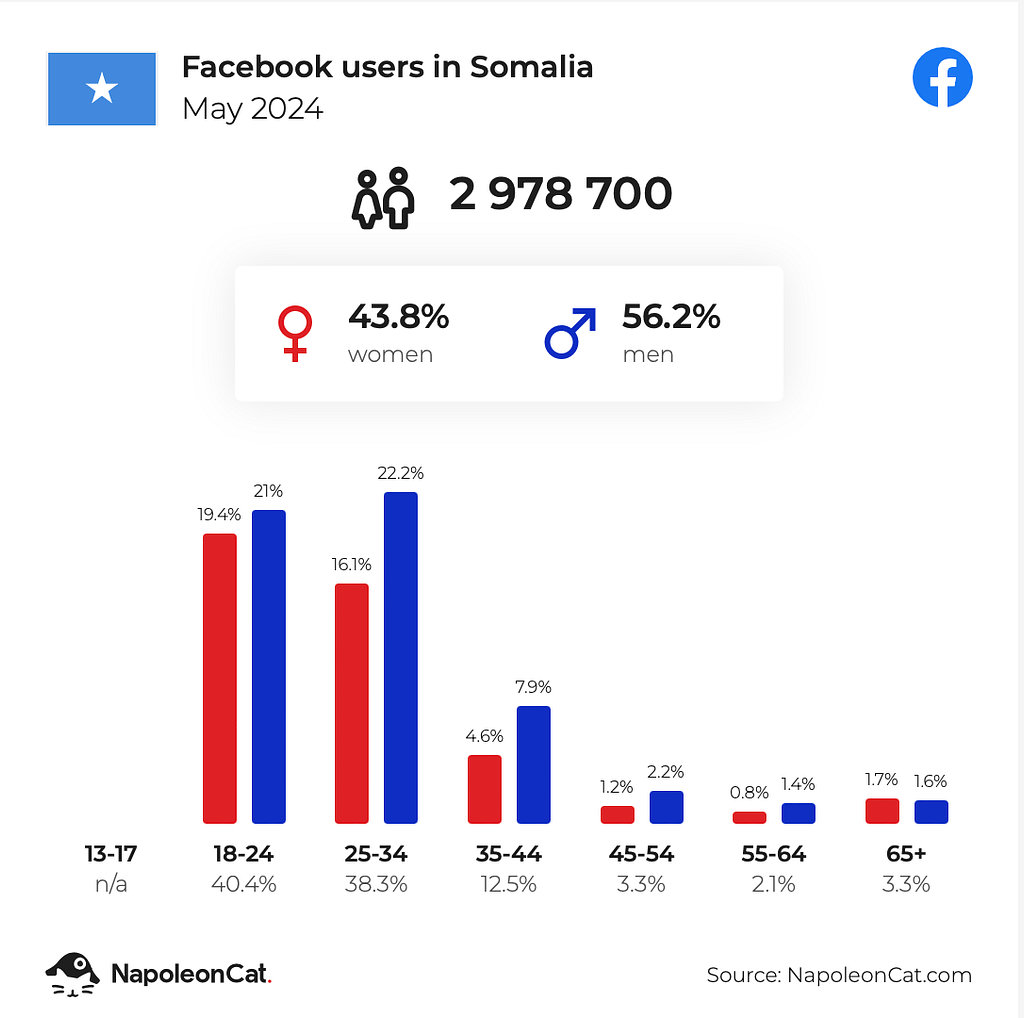
Social media usage in Somalia has seen significant growth, with over 2.9 million Facebook users as of May 2024. According to our research and additional screenshots, the demographics reveal the following:
Facebook Users: 2,978,700 (56.2% men, 43.8% women)
Instagram Users: 554,600 (52.7% men, 47.3% women)

LinkedIn Users: 326,600, with the majority aged between 25-34 years.
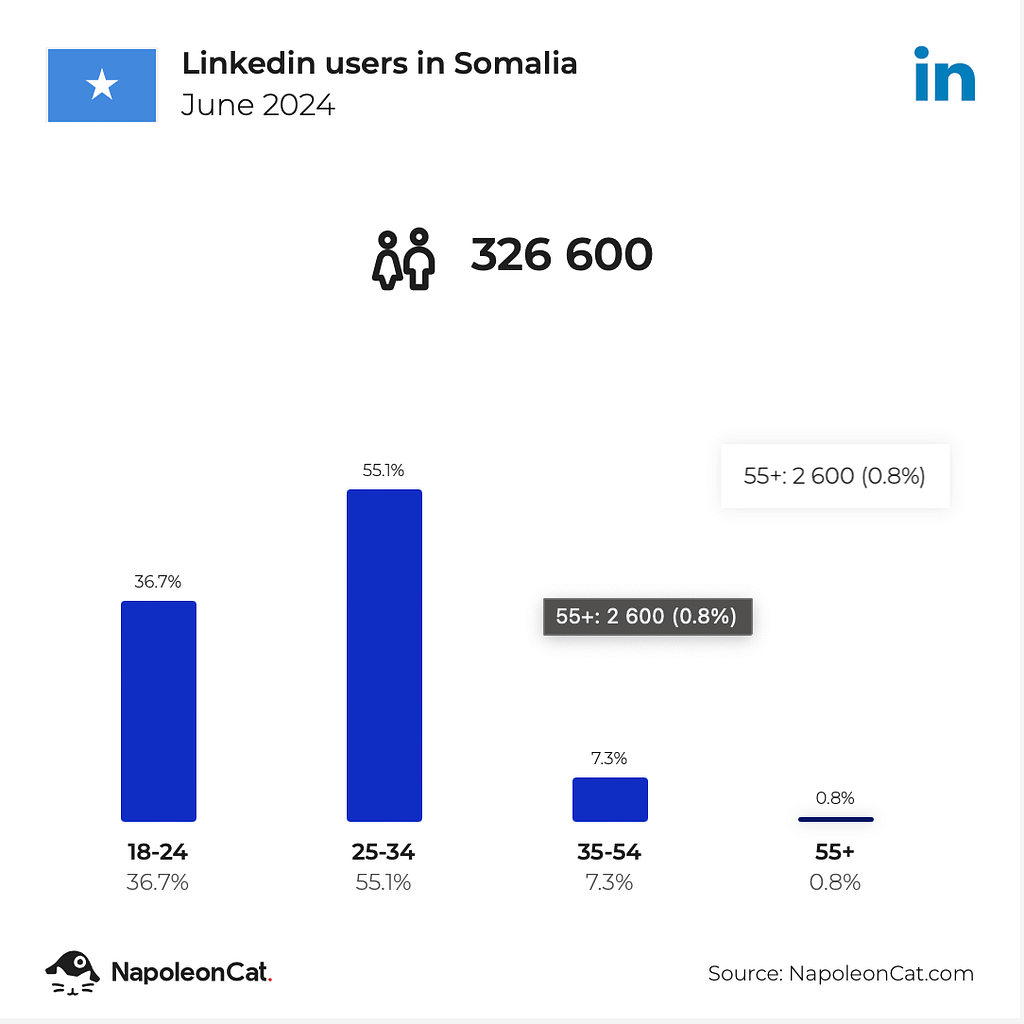
Social media Users stat Source
The social media users in Somalia stat has been sourced from Napoleoncat
Social Media Followers of the Ministries
foundational metric in assessing social media performance is the size of a ministry’s audience, as reflected in the number of followers across platforms. While follower count alone does not guarantee engagement, it serves as an indicator of the ministry’s reach and potential influence. The five Somali government ministries analyzed in this study exhibit significant variation in their follower numbers, reflecting differences in their outreach strategies, target audiences, and public interest in their areas of responsibility.
Follower Overview
- Ministry of Education: 402,400 followers
- Ministry of Internal Affairs: 85,300 followers
- Ministry of Foreign Affairs (Somali): 77,900 followers
- Ministry of Foreign Affairs (English): 49,400 followers
- Ministry of Energy: 17,000 followers
- Ministry of Fisheries: 15,100 followers
Comparative Analysis on Their Facebook Followers
The Ministry of Education leads the group with an overwhelming 402,400 followers, accounting for nearly half of the total followers across all five ministries combined. This dominance suggests a high level of public interest in education-related topics, likely due to the ministry’s direct relevance to students, parents, and educators.
In stark contrast, the Ministry of Fisheries has the smallest following, with just 15,100 followers. This significant gap highlights the ministry’s niche appeal and potentially less visible social media strategy. Similarly, the Ministry of Energy, with 17,000 followers, also struggles to attract a broad audience, possibly due to its technical focus and limited public-facing initiatives.
The Ministries of Foreign Affairs (Somali and English) and Internal Affairs occupy a middle ground in follower count. The Somali version of Foreign Affairs, with 77,900 followers, outpaces its English counterpart, which has 49,400 followers. This disparity likely reflects the Somali-speaking audience’s preference for content in their native language. Meanwhile, the Ministry of Internal Affairs, with 85,300 followers, demonstrates a relatively robust presence but still lags far behind the Ministry of Education.
Key Observations
- Audience Size and Relevance: Ministries with broader mandates, such as education and internal affairs, attract larger followings compared to ministries with more specialized focuses, such as fisheries and energy.
- Language and Accessibility: The higher follower count of the Somali Foreign Affairs account suggests that language plays a crucial role in audience reach. Ministries should prioritize content in languages their audiences are most comfortable with.
- Potential for Growth: Ministries with smaller follower counts, like Fisheries and Energy, have significant room to expand their audience by adopting more engaging and relatable social media strategies.
While follower count alone does not determine social media success, it is a crucial metric for understanding the potential reach of a ministry’s communication efforts. In the next section, we delve deeper into how these ministries capitalize on their follower bases—or fail to do so—through engagement strategies and content performance.
Distribution of Content: Number of Image and Video Posts
The type of content shared by ministries plays a significant role in their ability to engage with audiences. Social media platforms typically reward variety, with videos often generating higher engagement than static image posts. Analyzing the distribution of content types across the five Somali ministries provides insights into their communication strategies and preferences.
Comparative Analysis
- Balanced Strategy: Ministry of Education – The Ministry of Education demonstrates a nearly equal split between image posts (31) and video posts (29). This balance suggests a deliberate effort to diversify content, leveraging both static and dynamic formats to appeal to a broad audience. The success of their video content, as seen in their high engagement rates, underscores the importance of this approach.
- Preference for Images: Foreign Affairs (Somali and English) – Both versions of the Ministry of Foreign Affairs heavily favour image posts over videos. For instance, the Somali account shared 43 image posts compared to just 17 videos, while the English account posted 41 images and 19 videos. This preference for image-based content may limit their ability to capture audience attention, as videos typically perform better in terms of engagement.
- Moderate Balance: Ministry of Fisheries – The Ministry of Fisheries posted 38 image posts and 22 video posts, showing a moderate effort to include dynamic content. However, the relatively low engagement rates suggest that the quality or relevance of the content may need improvement, rather than simply increasing video output.
- Video-Inclusive Strategy: Ministry of Energy – The Ministry of Energy maintains a slightly better balance, with 40 image posts and 20 videos. While this indicates some awareness of the value of video content, the engagement data reveals that the ministry may need to further optimize its content strategy to resonate more effectively with its audience.
Key Observations
- Over-reliance on Images: Ministries such as Foreign Affairs (both versions) tend to rely heavily on image posts, which may not fully exploit the engagement potential of video content.
- Balanced Content Strategies Work: The Ministry of Education’s nearly equal distribution of image and video posts aligns with its high engagement rates, reinforcing the importance of variety in content strategies.
- Opportunities for Improvement: Ministries like Fisheries and Energy have room to increase the quality and relevance of their video content, as this format generally drives stronger audience interaction.
By examining the content distribution strategies of these ministries, it becomes clear that ministries focusing on a mix of images and videos are better positioned to capture audience interest. This comparison highlights the need for ministries to not only diversify their content but also tailor it to their audience’s preferences and platform-specific trends.
Post Engagement Of The Ministries
A critical metric in evaluating the performance of government ministries on social media is the total engagement they receive on their posts, including likes, shares, comments, and other Views. The total engagement provides valuable insights into how effectively a ministry’s content resonates with its audience. The five ministries examined in this research exhibit notable differences in their engagement levels, reflecting the diversity in their communication strategies, the relevance of their content to the public, and the intrinsic interest in their respective fields.
Engagement overview
Total Engagement of Posts
- Education: 161,975
- Foreign Affairs English: 5,934
- Foreign Affairs Somali: 5,926
- Internal Affairs: 3,168
- Energy: 2,185
- Fisheries: 1,398
Average Engagement per Post
- Education: 2,699
- Foreign Affairs English: 99
- Foreign Affairs Somali: 98
- Internal Affairs: 53
- Energy: 36
- Fisheries: 23
Breakdown of Engagement
To better understand the overall engagement metrics, we analyzed key aspects such as views, likes, comments, and shares for each ministry’s posts. This detailed breakdown highlights how different types of content perform and provides insights into the specific elements that drive public interaction. By examining these metrics, we can identify areas where each ministry excels or may need to improve to enhance overall engagement.
Analyzing Engagement Metrics of Somali Government Ministries
The Education ministry’s overwhelming lead in both total engagement (161,975) and average engagement per post (2,699) suggests a few key factors. Education is often a high-priority issue for the public, driving more interaction and interest. Additionally, educational content may be more varied and engaging, including announcements of new programs, success stories, and interactive content like quizzes or videos that can appeal to a broad audience.
In comparison, the Foreign Affairs ministries, both in English and Somali, have similar engagement levels (total around 5,930 and average around 99). This could indicate that while foreign affairs are important, they may not capture daily interest as intensely as education. Language differences also hint that the ministry’s content might be duplicated across both languages without tailoring to the unique needs of each audience.
The Internal Affairs ministry has moderate engagement (total 3,168, average 53), likely due to the nature of its content, which might be more procedural and less immediately engaging to the general public.
The Energy and Fisheries ministries have the lowest engagement (total 2,185 and 1,398, average 36 and 23, respectively). This lower engagement could be due to the specialized nature of their content, which may not resonate with the broader public as much as more universally relevant topics like education and foreign affairs.
Key Observations
- Education Ministry Dominance: The Education ministry’s total engagement is vastly higher than any other ministry, indicating a strong public interest and effective communication strategies. Education directly impacts a wide audience including students, parents, and educators. Posts related to educational developments, exam results, and new school initiatives are inherently engaging and important.
- Language-Specific Engagement: The nearly identical engagement for the Foreign Affairs ministry’s English and Somali accounts suggests that language may not be a significant factor in engagement levels if content is not customized for each audience.
- Public Interest: Ministries like Energy, and Fisheries deal with areas that may not generate as much public curiosity or emotional engagement. Their content can be more niche and technical, appealing primarily to stakeholders and professionals in those fields rather than the general public.
- Moderate Engagement: Internal Affairs shows moderate engagement, likely due to content that, while important, may not have the same broad appeal as educational topics.
Engagement rate
Engagement rate is a metric used to measure the level of interaction that content receives from an audience. It includes likes, comments, shares, and other forms of interaction that indicate audience engagement and interest. Understanding engagement rates is crucial for evaluating the effectiveness of social media strategies. This analysis compares the engagement rates of five ministries against the industry standard for Facebook engagement rates.
Industry Standard for Engagement Rates
The industry standard for social media engagement rates can vary significantly depending on the platform and industry. However, general benchmarks suggest thatFor government social media accounts, the average engagement rates are:
- Instagram: 4.2%
- Facebook: 3.2%
- X (Twitter): 2.4%
- LinkedIn: 2.0%
These benchmarks are based on average performance metrics across various industries and social media platforms. For more detailed and specific benchmarks, you can refer to resources like Hootsuite’s “Average Engagement Rates for 12 Industries” report and Socialinsider’s “2024 Social Media Industry Benchmarks“.
Comparative Analysis On The Ministries’ Enagement rate
- Education: Both video and image engagement rates are at 1.30%, which is significantly below the industry standard of 3.2%. This indicates that there is a lot of room for improvement in engaging the audience on Facebook.
- Foreign Affairs (English): Video engagement rate is at 0.40%, and image engagement rate is at 0.20%. These are far below the industry standard of 3.2%. It suggests that the content may not be resonating with the audience, or that the target audience is not being effectively engaged.
- Foreign Affairs (Somali): Video engagement rate is at 0.70%, and image engagement rate is at 0.30%. These rates are better than the English version but still significantly below the industry standard of 3.2%. There is a clear need for enhanced engagement strategies.
- Fisheries: Both video and image engagement rates are at 0.30% and 0.20%, respectively. These are well below the industry standard of 3.2%, indicating that the content is not engaging the audience effectively.
- Energy: Video engagement rate is at 0.60%, and image engagement rate is at 0.30%. These rates are below the industry standard of 3.2%, suggesting that the content could be improved to better engage the audience.
- Internal Affairs: Both video and image engagement rates are very low at 0.20% and 0.08%, respectively. This indicates a significant need for improvement in content strategy to engage the audience effectively.
Strategies to Improve Somali Government Social Media Performance
1: Understanding Target Audiences
One of the most significant insights from our analysis is the need for ministries to better understand their audiences. The Ministry of Education’s success in Somalia compared to its counterparts is attributed to its focus on students and educators, creating content that is both relevant and engaging. In contrast, ministries like Foreign Affairs and Fisheries fail to engage because they do not tailor their messages to their audience’s interests.
2: Content Strategy Matters
Content is king in the realm of social media. Ministries should prioritize engaging content that resonates with their audiences. For instance, posting success stories, community events, or informative infographics can foster deeper connections with followers.
3: Posting Frequency and Variety
Regular posting is crucial. Ministries should adopt a varied content strategy that includes videos, images, and interactive posts to maintain follower interest and engagement.
4: Engagement Strategies
To improve audience interaction, ministries can implement strategies such as:
- Polls and surveys to gather opinions and encourage participation.
- Q&A sessions to address follower inquiries directly.
- User-generated content campaigns to involve the audience in the conversation.
Conclusion: Driving Change Through Collaboration
The findings of this research highlight the urgent need for Somali ministries to reevaluate their social media strategies. By focusing on engaging content, understanding their audiences, and employing best practices from successful ministries, they can significantly improve their engagement rates. Explore how Vividscope can help ministries improve Somalia’s digital engagement.
Vividscope is committed to helping organizations enhance their digital marketing efforts. Our training programs equip communication teams with the necessary tools to thrive in the digital landscape. As we look ahead, we plan to conduct comprehensive research every six months to track the progress of social media engagement among ministries, with the next report due in January 2025.
As we continue this journey to redefine engagement in Somalia’s governmental landscape, we invite ministries and organizations to partner with us to revolutionize Somali government social media performance. Together, we can build a more informed and connected society.Explore how Vividscope can help ministries improve Somalia’s digital engagement. View our services.